Criticisms
Lee Kang Wook : Macroscopic Scenes Reflecting Microscopic Sensibility
2011.09
Liu Jienne | Curator of National Museum of Contemporary Art, Korea
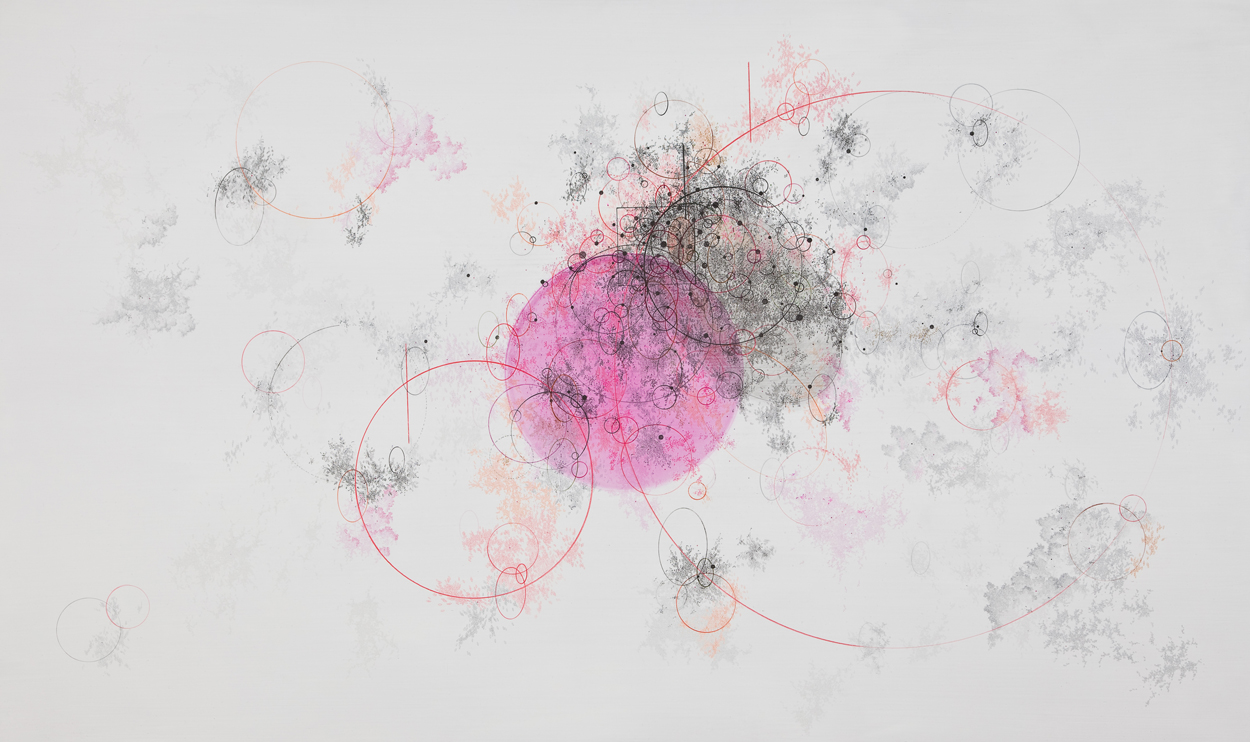
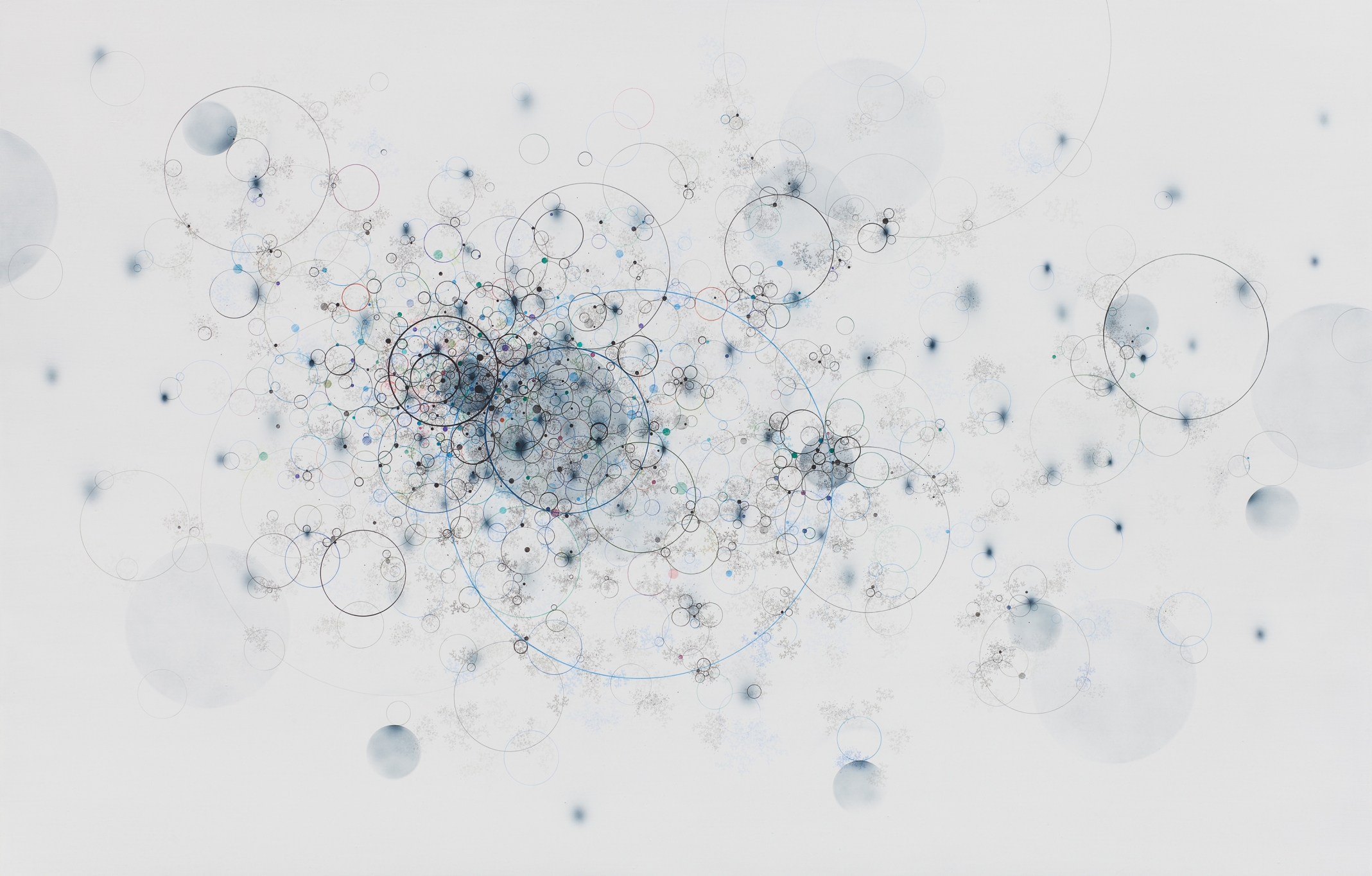
Untitled-11022, 2011, Mixed Media on Canvas, 95 x 160 cm ©Artist
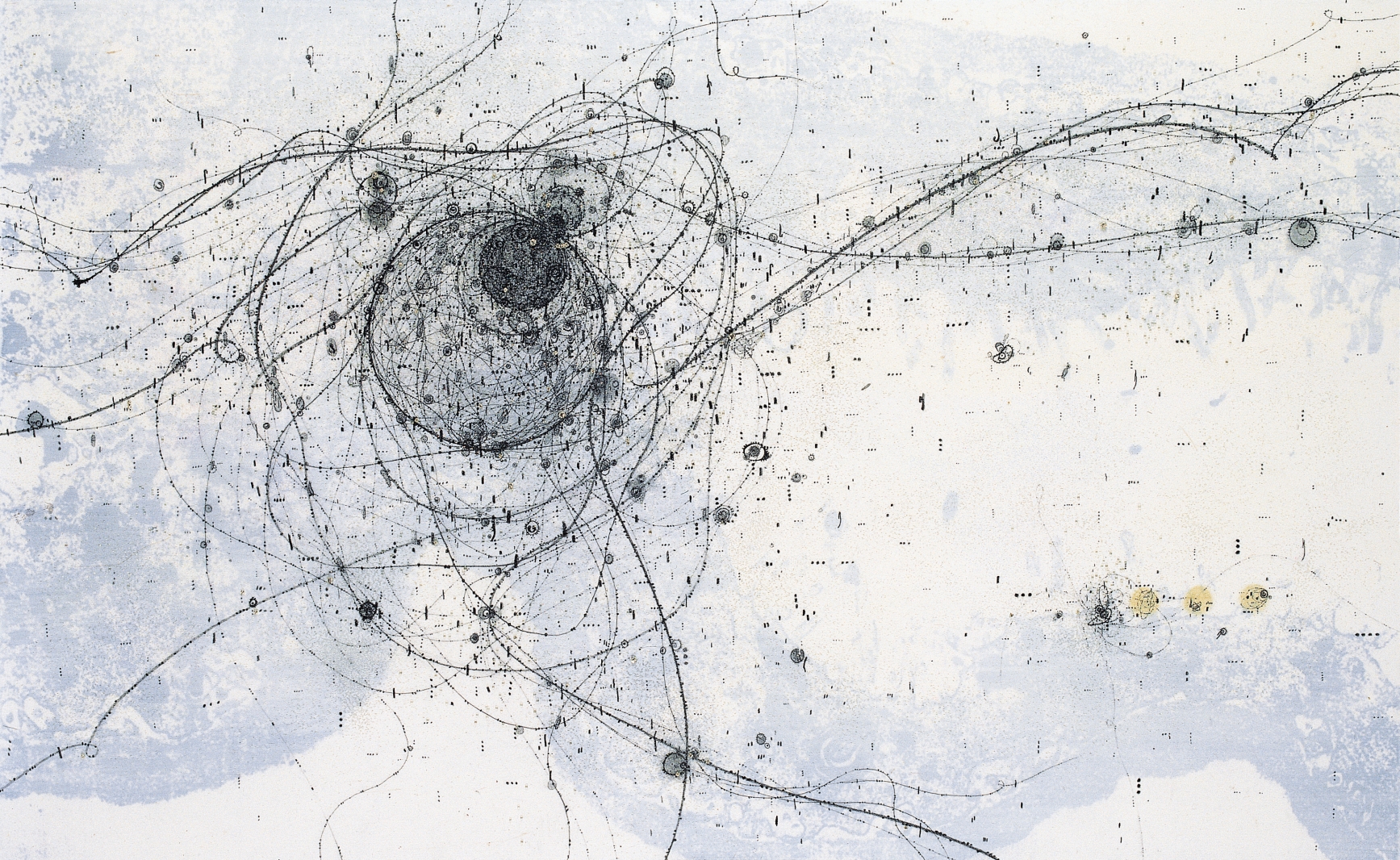
While works based on hyperrealism and narrative were mainstream in the early and mid-2000s, Lee was well known for abstract and simultaneously emotional scenes with a flavor of drawing represented by delicate surface treatment. In ‘Invisible Space’, Lee tries to depict the space he inhabits, his surroundings, the nature he views, and his idea of the universe.
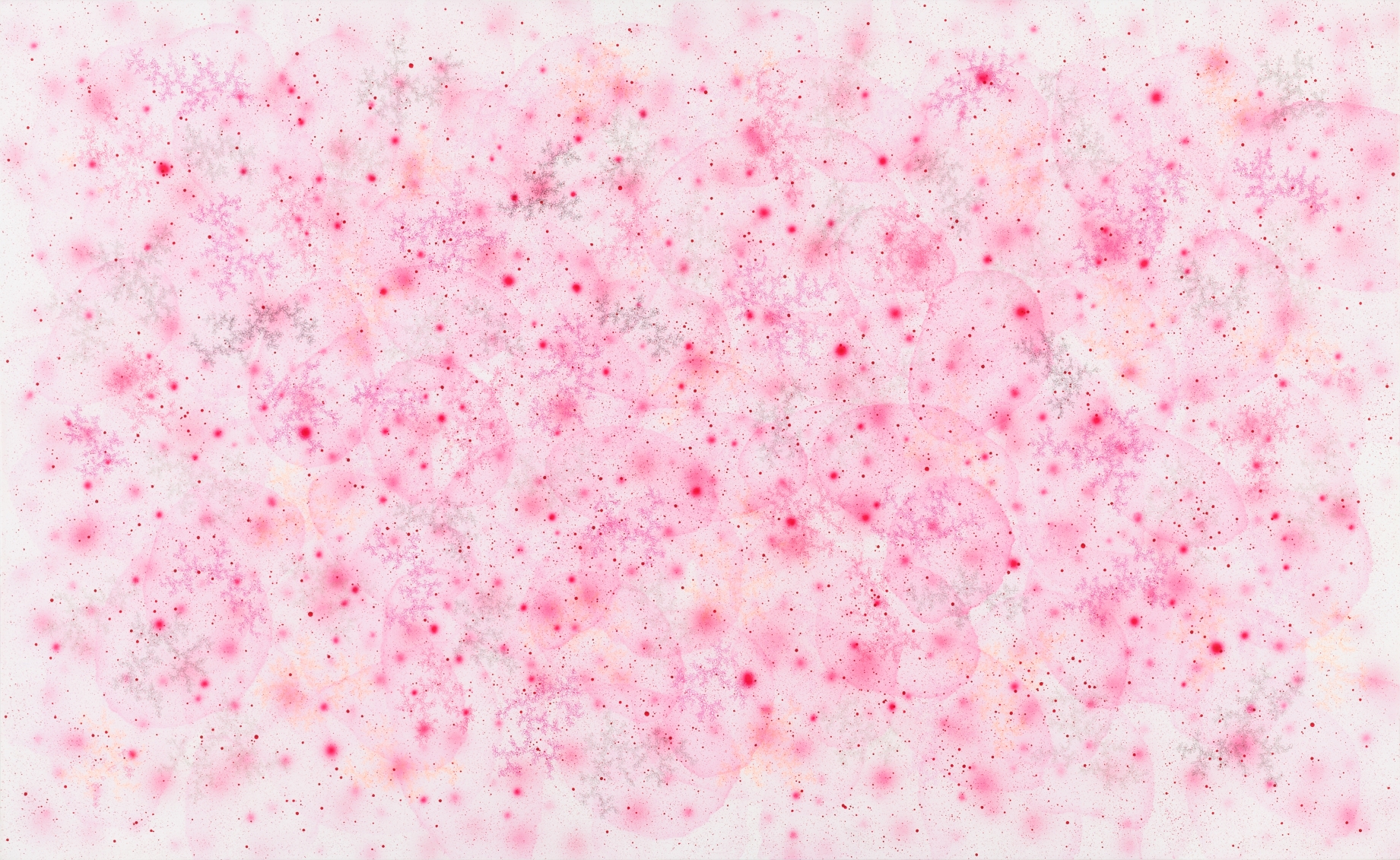
Lee’s work initiates from his exploration of himself and takes note of the images of cells as the basic unit of living creatures. He presents both a microscopic and macroscopic view of the world, as the result of his realisation that infinite space is included in tiny cell images.
In ‘Invisible Space’ cell images on a pastel-coloured background appear ambiguous in detail but reveal a certain sense of existence. Gentle curves and glittering beads on the surface emphasise organic complexity and extendibility, while relations between dot and line, colour and light in a multi-layer structure create space in an organic, continuous, and tense state rather than demonstrating the world Lee perceived in a complete state. This is a world entangled and expanded on canvas and shows a successful representation of a world of infinite senses, not a representation of a world of daily affairs.
After studying abroad in 2009, in a belated attempt to seek change in his work, Lee Kang Wook returned to Korea to hold his solo show. The first question that came to mind after seeing the pieces from the show was “Were you happy while you were studying overseas?” This question might be meaningless for the artist, but he said that studying abroad was an opportunity to look back on himself and reflect on his practice.
The reason I asked this question was because of the considerable change I had noticed in his work over the last two years. Those who study overseas may think they had a meaningful time, but this does not make completing a work any easier.
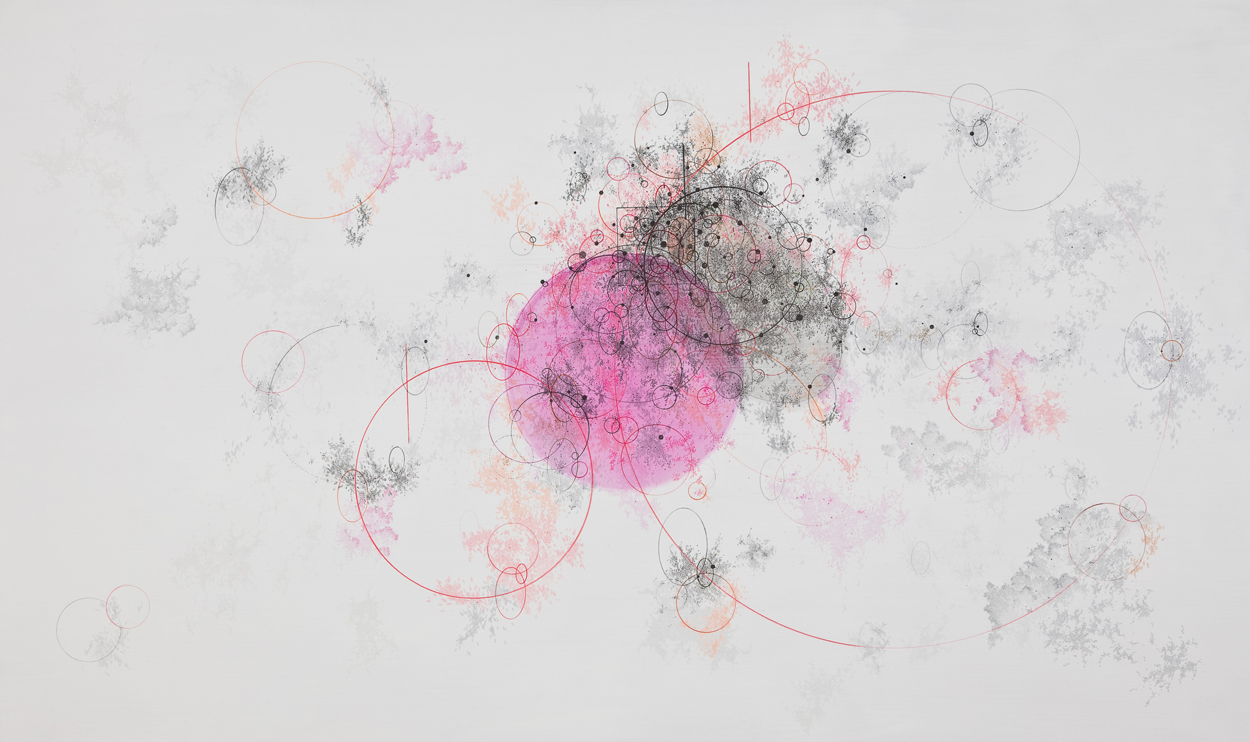
The salient features of Lee’s recent work are tiny circles irregularly arranged, indicating subtle changes in light and shade, clear colour fields and outlines in the foreground. As the glass beads that determined the surface feel of his previous work disappear, pure modeling elements appear in white space. I get the impression that the components of his work have become vivid and the content has become more abundant beyond a sleek, bright feeling.
The change in Lee’s recent series ‘Untitled’ is evident in the direction and distance beyond a fragmentary consciousness of size, whether large or small. That is to say, while images familiar to us disappear according to the gaze, gradually becoming closer or more distant in the process of seeing the outside from the inside, or the inside from the outside, new images appear. The artist encapsulates such change and sense of distance in accord with the movement of the eye. In this sense, his work is now based on process or purpose, rather than consequence.
The tiny circles emerging as a result of this deep infiltrating gaze are of great significance in the pictorial image as a whole. The repetition of these small circles generated by and bearing his gestures, is more considered than action painting and reflects his delicate sensibility. The tiny circles in his work since the late 1990s are an extension of his exploration of such questions as “Who am I?” and “What is the smallest unit forming me?” The cell images Lee depicts as the smallest unit to represent man and the world are therefore symbolic of a process of unfolding his world of contemplation and information.
While such circles rendered by delicate hand movements appear gradually deeper, at the same time geometrical figures gradually protrude onto the outside of the canvas. If these figures exist independently, they look static, but as they are connected sequentially, they look dynamic. The overlap of forms engenders an illusion of three-dimensional space in an unstable state, but in Lee’s work organic and geometrical images do not bring about a three-dimensional effect as they are in equilibrium with equal meaning.
Although figures with different characters overlap in his work, the figures do not come into conflict. With this Lee does not give up the flatness of painting. As the colour fields have no sense of weight, they appear unintimidating along with outlines, and are inter-overlapping and inter-infiltrating, thereby helping to emphasise such pictorial flatness.
Geometrical forms as apparently accurate manifestations symbolise perfect forms for themselves, referring to a completed state all can perceive. Remnant tiny circles are symbolic of extremely individual documentation and expression of emotion in a constantly changing incomplete state. The outlines are psychological, natural, and the simplest means to express images by hand.
Empty space on canvas here is a contact area between geometrical and organic layers, and space as a whole is where the two heterogeneous elements coexist. If seen from the perspective of Formative Psychology, the clusters of such tiny circles exude a disquieting effect with a mixture of stability and instability and the crossing of closely located, fluid elements.
The colour fields and outlines on such a background are emphasised as elements contrasted with empty space and tiny circles and read as elements separated from the background. We may have a preconceived opinion that a sense for composition is required to harmonise heterogeneous elements such as texture, direction, size, colour, and form or for revealing the features of figures, but Lee’s work is otherwise. Multiple sensibilities are demanded to perceive organic images as sensuous expressions and geometric forms as objective together.
The dichotomous principle on objectivity and subjectivity is derived from The Upanishads philosophy with which Lee has recently become concerned. According to Lee, coexistence and coincidence between immutable principles and emotional elements as ways to pursue the truth are the condition to proceed to complete being. Although Lee seems to depend on automatism, he intends to showcase extremes and simultaneously neutralised states through tremendously temperate, prearranged work.
Lee Sook-Kyung argues that “This situation in Lee’s work seems to explore some cosmic order inherent in contrasting worlds, represented in his fundamental composition extended by seemingly controlled yet spontaneous patterns and forms.” She goes on to explain that “Such a feature is the fusion or composition of conflicting worlds beyond mere dualism.” The overlap of forms and fusion of small circles therefore, provokes a constantly moving mood of some order without a specifically fixed point of view.
His scenes are filled with resonances derived from the complex features of clusters and individual points, the regular and irregular, tension and relaxation, vigilance and carelessness, and complexity and simplicity. With these characteristics, his images gain autonomous feeling that expands and contracts irrespective of the size of the canvas.
Lee’s recent work can be seen as amusement stemming merely from visual stimuli and a simple harmony of patterns, or as his firm assertion for actual modeling work to realise his ideas. He understands that a painter is someone who can bring about and be concerned with the effective development of an austere methodology, and his painting represents a candid self-confession conveying his practical purpose. This realisation has further reinforced his belief in pictorial flatness and purity.
Through this time of brief yet profound self-reflection, he has solidified his ideas of who he is, what his character and concerns are, and what attitude and behaviour he wants to pursue as a painter, trying to encapsulate this in his work. His recent work is thus a representation of his present life and a preview of his work’s upcoming development.
We need to look forward to what he will create rather than making past-dependent evaluations by comparing his current work with that of the past. While his recent work shares similarities with the pieces he completed over the last 10 years, it conveys completely different narratives.
Writings